Göcek sits about twenty kilometres east of Dalaman Airport, close enough that a car reaches the turning before most passengers have finished complaining about passport control. Nearly everybody passes straight through. The D400 skirts the town, dives into the Göcek tunnel and delivers its traffic to Fethiye without much sense of what has been bypassed.
What has been bypassed is a harbour.
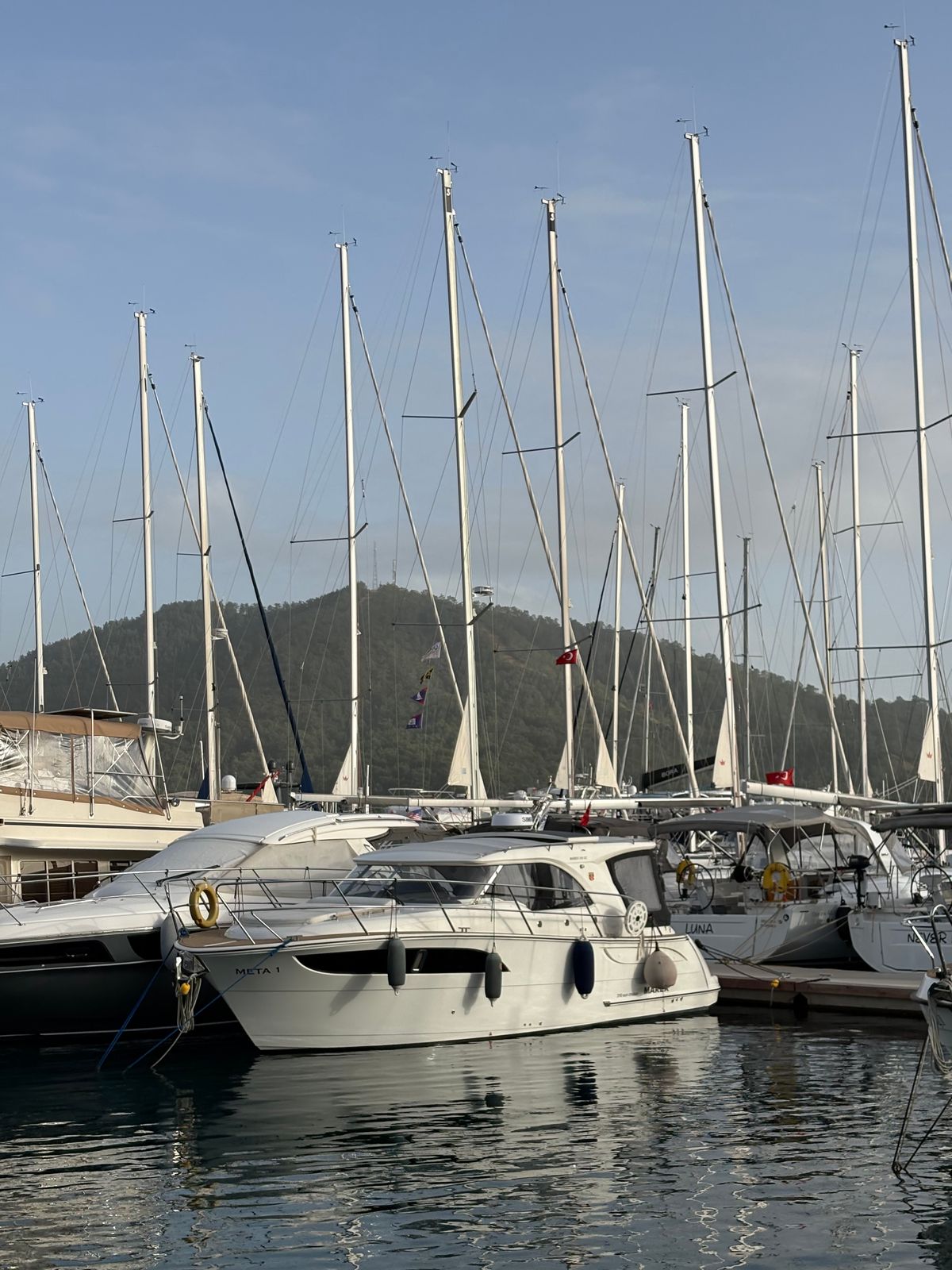
Göcek is arranged around boats to a degree unusual even on a coast full of them. Six marinas share roughly two kilometres of waterfront, and the shops behind them sell rope, charts, fenders, engine filters and crew laundry. A working port with restaurants attached, not a resort with a quay.
A town arranged around its moorings
Walk the waterfront west to east and you pass the municipal marina, then Skopea Marina, Club Marina, D-Marin Göcek and the Marintürk village port, each with its own gate, office and row of sterns pointing at the promenade. Yachts moor stern-to here, Mediterranean style, so the town spends summer looking at transoms and boarding ladders.
Göcek is also an official port of entry, so yachts clear customs here rather than sailing on to Fethiye or Marmaris. That single administrative fact explains much of the character: crews arrive, provision, fix things and leave from it.
Daily rhythm follows the boats. By half past ten the day trips have gone and the centre is almost empty, which is the pleasantest hour to be in it. Around six it reverses — engines in the channel, showers running, waterfront tables filling from the seaward side.
Why it looks the way it does
Nothing in Göcek is tall. No white ten-storey blocks on the hillside, no illuminated hotel signage visible from the water, no strip of neon behind the beach. This is not an accident of taste — the surrounding area was brought under special environmental protection in 1988, and building has been constrained ever since. Two storeys is the working limit for most of the centre.
Its main street runs a block inland, parallel to the sea and shaded along most of its length by trees planted close enough to meet overhead. On a July afternoon that shade is the difference between a walkable street and an unusable one.
Restraint is not modesty. Göcek looks understated because the rules require it, and the scarcity that follows pushed it to the expensive end of this coast rather than the cheap one. Low-rise here signals money, not thrift.
Day boat, or a week on a gulet?
Two quite different propositions leave from the same quays, and confusing them is the commonest planning error here.
A day boat — günlük tekne — is a shared trip. You buy a seat, board around ten, eat on board, swim at four to six anchorages and are back on the quay before dinner. Hulls carry between twenty and sixty people. No experience or planning required, and it costs less than a decent waterfront meal.
A gulet is the other end of it: a broad-beamed wooden motor-sailer, crewed, chartered by the week, either as a whole boat or cabin by cabin. Routes usually run Göcek to Fethiye, or west towards Marmaris and the Gulf of Gökova. Turkish tourism calls this a mavi yolculuk — a blue voyage — and the phrase carries a literary weight it does not always earn.
Be clear about one thing before booking a gulet week: it is not a sailing holiday. Most gulets motor almost everywhere, and the sails come out for photographs and the occasional favourable afternoon breeze. To actually sail, charter a yacht — bareboat or skippered — which Göcek does about as well as anywhere in the eastern Mediterranean. Several fleets are based here, and the gulf is sheltered enough to forgive modest qualifications.
The twelve islands, and what is actually on them
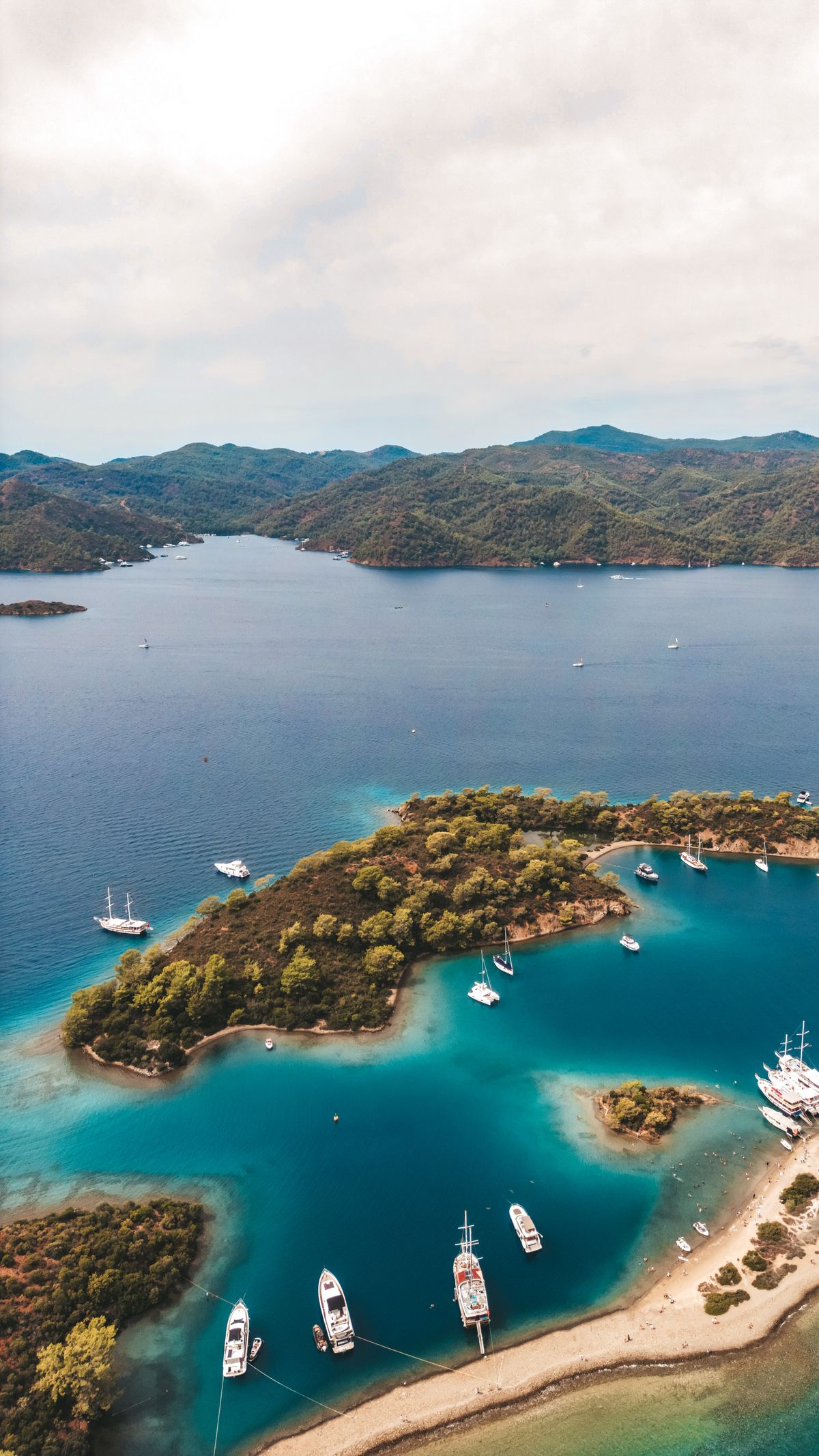
The count is loose. Skopea Limanı — the enclosed water between Göcek and the mouth of the Fethiye gulf — holds about a dozen islands, depending on what counts as one, and the tour boards rounded it to twelve long ago. No boat visits all of them in a day.
| Stop | What it is | Worth it? |
|---|---|---|
| Yassıca Adaları | Low flat islets, shallow sandbar between two of them | Yes — and the busiest anchorage in the gulf |
| Tersane Adası | Largest island; abandoned village and shipyard remains | The only stop with something to walk to |
| Hamam Koyu | Submerged walls, known as Cleopatra's Hamam | Briefly — swim over it, don't climb it |
| Domuz Adası | Privately owned, viewed from the water only | A photograph, nothing more |
| Bedri Rahmi Koyu | Fish painted on a shoreline rock by the artist it is named for | Pleasant anchorage, modest attraction |
| Göbün Koyu | Quiet inlet, rock-cut tombs above the shore | Underrated, often skipped |
Tersane Adası deserves more than a swimming stop. Its name means shipyard, and there was a real one — slipways, cut stone, the bones of an industry. Its village was Greek-speaking and emptied in 1923, when the population exchange between Greece and Turkey moved the inhabitants across the Aegean. Roofless houses, cisterns and the shell of a chapel remain in the scrub above the bay. Boats that put passengers ashore give you perhaps forty minutes, enough to see it and not enough to understand it.
Cleopatra's Hamam, in Hamam Koyu, gets oversold. Masonry genuinely sits half-submerged at the head of the bay, and swimming above it is a strange and good sensation. Attribution to Cleopatra is folklore — the visible stonework reads as late Roman or Byzantine, drowned by slow subsidence rather than romance. Go anyway, and adjust the story.
How a day boat actually runs
Boarding runs from about half past nine, at the municipal quay or a marina pontoon. Look at the boat before buying the seat: shade coverage, cushion condition and how many are already booked matter more than the price gap between operators.
Then the shape of it, more or less:
- Out through the channel and among the first islands within twenty minutes — this gulf is small.
- Four to six anchorages, each thirty to fifty minutes. Ladder down, swim, ladder up.
- Lunch on board around one, usually grilled chicken or fish with salad, bread and rice. Drinks are extra and dearer than ashore.
- One stop, at most, where anyone goes ashore.
- Alongside again between half past five and six.
Take cash, a towel, reef shoes for stony landings and more sun cover than you expect to need. Sea temperature runs around 22°C in June, touches 27°C by late August and stays swimmable well into October.
August is the wrong month for this. Fifteen boats raft up in the same bay at Yassıca, each with its own music, the water between them full of tenders and inflatables. June and late September deliver the same coastline with a third of the traffic.
What Göcek is not
This is not a beach resort, and people who book it expecting one are reliably disappointed. There is no proper town beach — a small municipal strip, and paid beach clubs a drive out. Swimming here means getting on a boat; without that intention, the town has very little for you.
Nightlife barely exists. A handful of waterfront bars stay open late enough for a second drink, and that is the extent of it. Crews eat, drink moderately and return to their boats, most of them sailing in the morning. Anyone wanting noise goes to Fethiye or further.
And it is expensive. Waterfront restaurants charge closer to Bodrum prices than Ortaca ones, and berthing rates in these marinas sit among the highest in the country. Göcek is beautiful, well run and entirely aware of both facts.
Getting there, and away
From the airport it is roughly twenty kilometres and twenty-five to thirty minutes — the shortest run in this register bar Sarıgerme, worth knowing if your flight lands late. Options are set out in the entry on airport transfers.
Eastward, the D400 covers the twenty-seven kilometres to Fethiye through the Göcek tunnel, opened in 2007 to replace a slow hairpin climb over the ridge. There is a toll. Paying it still beats the old road, which survives as a scenic alternative for anyone with time and a strong stomach. Dolmuş minibuses run to Fethiye every twenty to thirty minutes in season, far less often outside it, and seasonal boats cross the gulf to Fethiye harbour — a much better journey, at about twice the duration.
Come in May, June, late September or October: calm gulf, half-empty anchorages, manageable heat. The register's notes on timing go further into that. Regional background comes from GoTürkiye, the ancient geography here — the old boundary between Lycia and Caria ran close by — is summarised by Britannica, and the Ministry of Culture's culture portal lists sites across the province.