Dalyan lies about thirty kilometres from Dalaman Airport and twelve from the D400 at Ortaca. The Dalyan Çayı leaves Köyceğiz Lake, loses itself in a delta of reed channels, and eventually finds the sea at İztuzu. A town grew along one bank of it, low and narrow, facing a cliff.
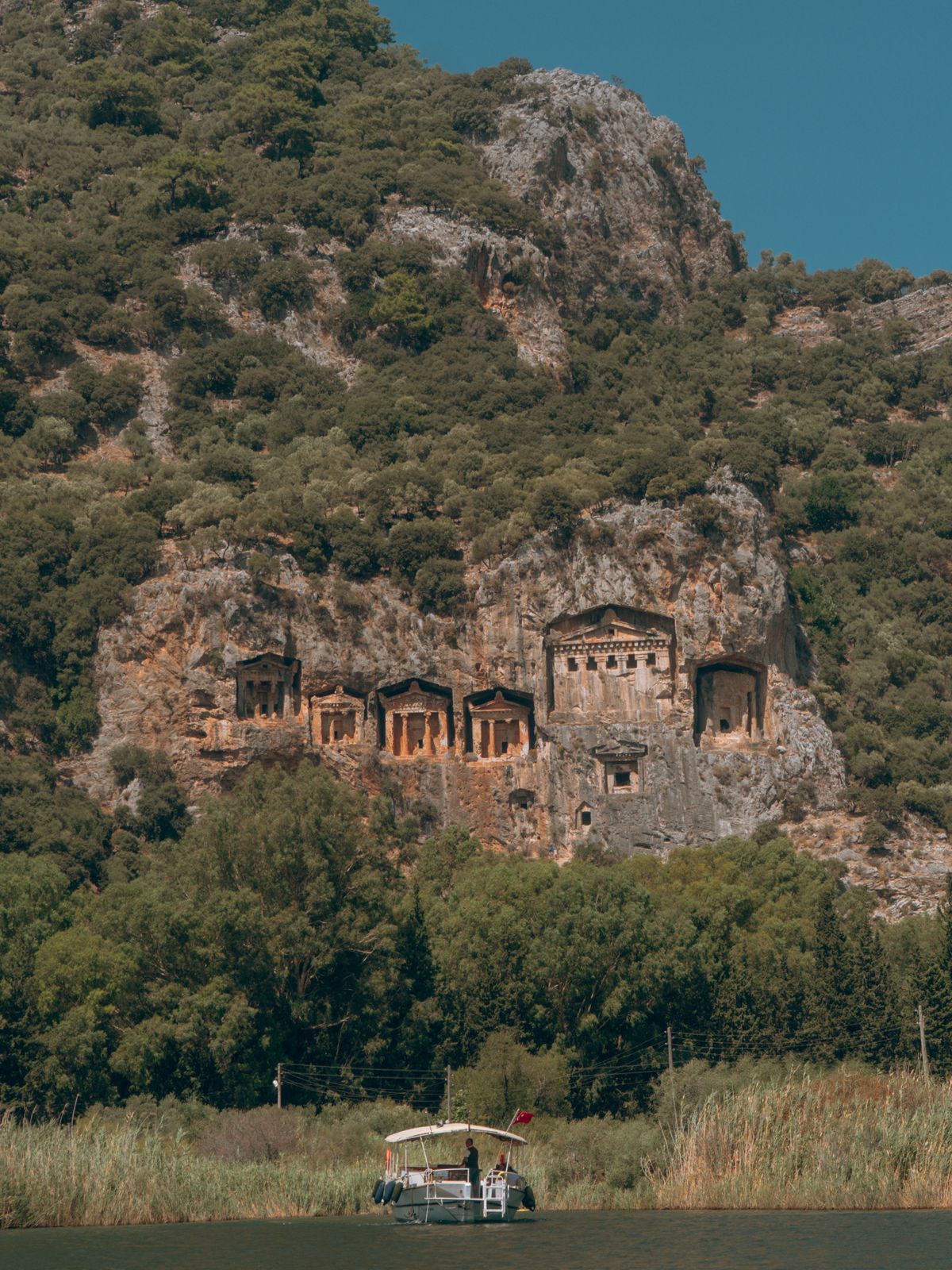
Cut into that cliff, directly opposite the waterfront tables, are the tombs.
They are why most people come, and they deliver on first look — from a café chair, without a ticket.
The tombs across the water
Six large temple facades are carved into the rock above the far bank, plainer chambers scattered around them. Each has two Ionic columns, an architrave and a pediment — a small Greek temple quarried out of the cliff and pushed back in. They were cut for the rulers of Kaunos, the city behind the ridge, and date to the fourth century BC.
Their style is Lycian. Kaunos was Carian. This coast sat on the seam between the two, and the cliff is where that seam shows — a Carian city burying its dead in its neighbours' architecture.
One facade was never finished. Its lower half is a crisp temple front; above that the rock is rough, the columns only blocked out. Whatever stopped the work stopped it mid-cut, and it has stayed that way for twenty-four centuries.
After dark the town floodlights the row: orange facades against black rock, the reflection breaking up in the current.
What you cannot do is reach them. Fencing, and a long-standing closure, leave the whole thing a view — ten minutes from the promenade, twenty if you walk the bank. Arrive expecting to climb inside and you will be flat.
Kaunos, and the harbour that silted up
That city sits on the same far bank, and getting there is half the pleasure. Small rowing boats cross from the town side all day: three minutes, very little money, a path through the reeds at the other end.
Kaunos was already old and famous when Herodotus wrote about its people in the fifth century BC. What survives runs up a steep hillside: a Hellenistic theatre seating something like five thousand, Roman baths, a basilica's foundations, a terrace above the old harbour, and an acropolis on the rock at the top under medieval walls.
Climb to the acropolis and the whole problem of Kaunos is laid out underneath you.
Here was a port. Its harbour is now a landlocked pond — Sülüklü Göl, the leech lake — sealed off by silt the river kept bringing down. Water went stagnant, summer fever followed, and the Kaunians' complexion became an ancient byword for unhealthiness. Modern Dalyan stands on ground that did not exist when the tombs were carved.
Kaunos was killed by its own river, slowly, across centuries. Dalyan lives off that same river now — irony or continuity, depending on the day.
Entry is ticketed, and the Ministry of Culture and Tourism publishes current hours through its museums portal. Shade barely exists on the climb — in July, go at opening or not at all. Wikipedia keeps a fuller account of the excavations.
The boat trip, and what it actually is
Almost everyone in Dalyan ends up on a boat, and almost everyone ends up on the same boat trip.
A river cooperative runs the fleet and fixes the fares, which removes the haggling and also the variety. A standard day leaves the quay around half past ten and is back on its mooring by late afternoon.
| Stop | What it is | Time usually allowed |
|---|---|---|
| Rock tombs | A slow pass beneath the cliff | 10 minutes |
| Reed channels | Delta labyrinth and standing fish weirs | 30–40 min each way |
| İztuzu Beach | The sea end of the river; turtle nesting sand | 2–3 hours |
| Mud baths | Sulphur pool and mud pit at Sultaniye or İlıca | About an hour |
| Köyceğiz Lake | Open water, sometimes Köyceğiz town | Varies by boat |
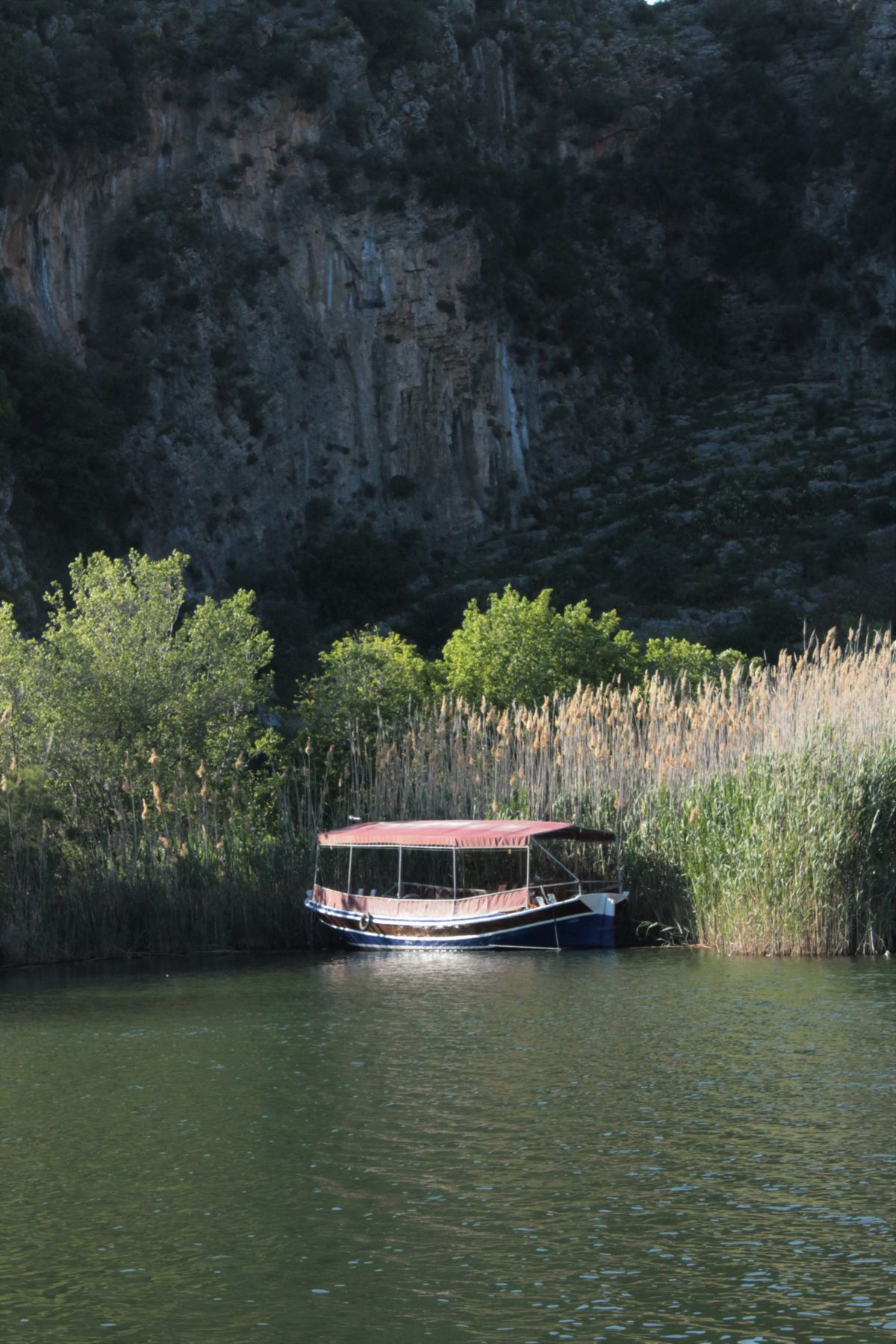
Channels are the part that stays with you. Reed three or four metres high closes in on both sides, the route narrows to little more than the width of the hull, and the boat takes blind corners with the engine throttled back. Wooden weirs still block sections of water — dalyan means fish weir — trapping grey mullet and sea bass on their run between lake and sea. Their roe is still salted and pressed here.
Now the flaw. Boats leave inside the same hour, run the same route and allow the same time at each stop, so they arrive everywhere as a fleet — thirty hulls tie up at İztuzu within twenty minutes. Hiring privately buys you the boat, not the solitude.
If the channels are the reason you came, take a small boat out at five in the afternoon, once the fleet is back on its moorings. Same water, a tenth of the traffic, better light.
Are the mud baths worth it?
Sultaniye sits on the southwestern shore of Köyceğiz Lake, where sulphurous water comes out of the ground at around forty degrees. Bathers have used these springs since antiquity, and the usual claims about skin and joints come attached.
Nobody improvises the ritual. You wade into a shallow pool of grey mud, coat yourself, stand in the sun until it dries and cracks, rinse, then sit in the sulphur pool for as long as the smell allows.
None of it is a spa. It is a crowded, faintly grubby tourist ritual, and expecting anything else is the mistake. Several hundred people churn that mud pool daily and nobody changes the water while you watch. Sulphur gets into swimwear and does not fully leave. Whether the hour reads as good fun comes down to your tolerance for other people's enthusiasm.
A second, smaller mud bath sits closer to town on the İlıca channel, and many day-boats use it rather than running up to Sultaniye. Quicker, marginally quieter, a different place. If an itinerary says only "mud baths", ask which.
The town that was not allowed to grow
Dalyan is low. No towers on the waterfront, no ten-storey all-inclusives on the approach road, a skyline of roofs and eucalyptus rather than concrete. That is not an accident of taste.
In the mid-1980s a large hotel development was proposed for İztuzu, on the sand where loggerhead turtles nest. Opposition was small, local, stubborn and internationally loud, and it won. By 1988 the Köyceğiz–Dalyan area had been designated a Special Environmental Protection Area, capping building heights. Everything pleasant about the town's proportions follows from that fight.
What remains is pensions, small hotels and one strip of riverside restaurants, all with the same view and much the same menu of grilled fish, gözleme and pide. Evenings are quiet — a few bars, nothing resembling a club. Anyone wanting the volume of Marmaris will find Dalyan dull by the second night.
- Two nights — the tombs, Kaunos, one full day on the water.
- A week — only if a slow river town with short evenings is the point.
- A day trip — fine from Sarıgerme or Göcek, tight from Fethiye, and it costs you İztuzu.
Arriving, and when to come
No airport coach serves Dalyan. Havaş runs east to Fethiye and west to Marmaris; the town is on neither route. That leaves a taxi, a car arranged before the flight, a hire car, or the slow way — coach to Ortaca on the D400, then a dolmuş for the last twelve kilometres. That minibus is cheap and takes about twenty-five minutes — and is the wrong choice at one in the morning with three suitcases. Driving yourself, allow forty to fifty minutes. This register weighs the alternatives in the airport entry and maps the local network in getting around the coast.
May, June, September and the first half of October are the months this register would pick. Water is warm enough from June, light is better either side of high summer, and boats still run. July and August are hot, and mosquitoes here are a feature rather than a rumour — the same reason Kaunos had a fever reputation two thousand years ago.
Winter shuts most of it. Boats stop, many hotels close between November and March, and the river goes grey and empty — a real town rather than a visited one.
One last thing worth planning around. Downstream, the beach at the river mouth is the other half of Dalyan, and a two-hour boat stop sells it short: İztuzu deserves a day of its own, reached by road, after the fleet has gone home. Regional listings for the province sit with the national tourist board at GoTürkiye.